Healthcare AI Safety Risks Are Back in the Spotlight
Healthcare AI safety risks are making headlines again after new research published on 4 March 2026 in The BMJ raised fresh concerns about the reliability of ChatGPT-style tools in clinical settings.
Artificial intelligence is already embedded in American and British healthcare — from hospital triage systems to diagnostic imaging and online symptom checkers. But the latest findings suggest that healthcare AI safety risks may be more complex, and potentially more dangerous, than many patients realize.
For everyday people in the US and UK, this isn’t a tech story. It’s a safety story.
You can read the original BMJ research here:
👉 https://www.bmj.com/
What the BMJ Study Found
The 4 March 2026 analysis in The BMJ examined how large language models — similar to ChatGPT — perform when used in clinical reasoning and patient-facing scenarios.
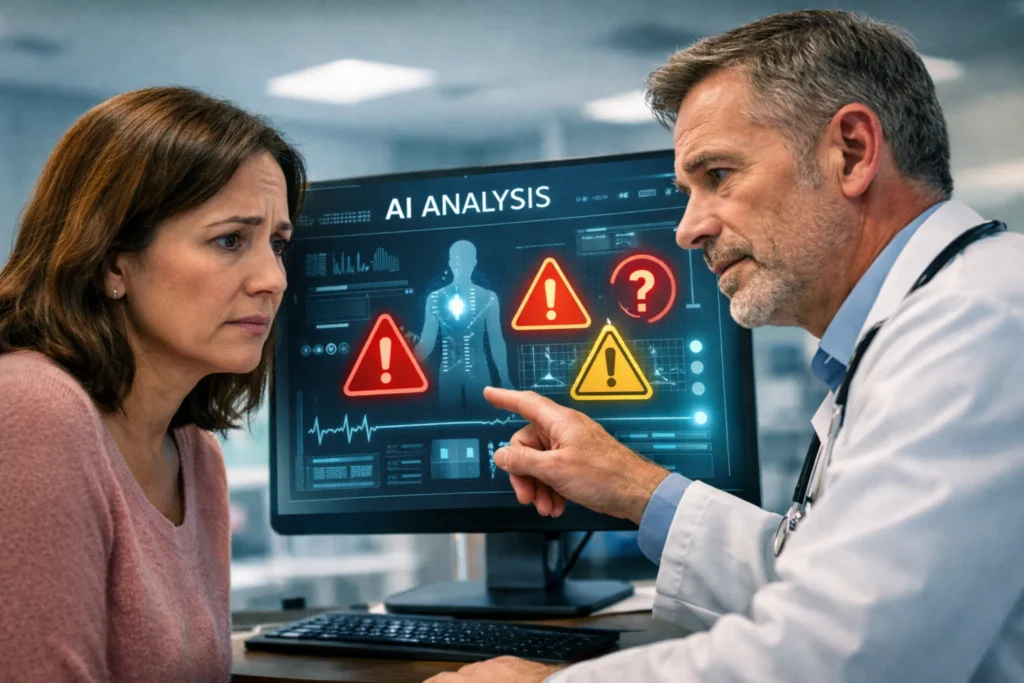
Researchers highlighted several healthcare AI safety risks, including:
- Confident but incorrect answers
- Failure to recognize critical red-flag symptoms
- Bias in outputs
- Inconsistent clinical reasoning
- Over-reliance by clinicians
One major issue raised was automation bias — the tendency for healthcare professionals to trust AI outputs even when they conflict with clinical intuition.
That matters because once a digital tool is embedded in workflow systems, it can subtly shape decisions at scale.
Why Healthcare AI Safety Risks Matter in the United States
The US healthcare system is aggressively integrating AI.
From private insurers to large hospital networks, AI is being used for:
- Risk prediction
- Radiology image interpretation
- Clinical documentation
- Triage support
- Patient chat systems
The scale of adoption means that even small healthcare AI safety risks can affect millions.
The US Centers for Disease Control and Prevention (CDC) provides guidance on digital health tools and patient safety considerations:
👉 Centers for Disease Control and Prevention — https://www.cdc.gov/
While AI can improve efficiency, the CDC emphasizes that technology must support — not replace — clinical judgment.
The UK Perspective: NHS and AI Oversight
In the UK, the NHS has been piloting AI tools across multiple trusts, including diagnostic imaging and digital triage services.
The NHS outlines principles for safe AI adoption, including:
- Transparency
- Clinical validation
- Human oversight
- Ongoing monitoring
More on NHS digital transformation and safety standards:
👉 https://www.nhs.uk/
However, the BMJ publication suggests that real-world deployment may move faster than safety validation.
The Core Healthcare AI Safety Risks Identified
Let’s break down the main risks flagged in the BMJ research.
1. Confident Misinformation
Large language models generate fluent, persuasive responses. But fluency is not the same as accuracy.
In clinical contexts, a confidently wrong suggestion can delay diagnosis or treatment.
For example:
- Mislabeling chest pain as anxiety
- Underestimating stroke symptoms
- Minimizing signs of sepsis
Even small diagnostic missteps can have life-threatening consequences.
2. Hidden Bias
Healthcare AI safety risks also include demographic bias.
If training data underrepresents certain groups, AI tools may:
- Misinterpret symptoms in women
- Underestimate cardiovascular risk in Black patients
- Miss atypical presentations in older adults
Bias in healthcare AI isn’t just a fairness issue — it’s a patient safety issue.
3. Over-Reliance by Clinicians
The BMJ researchers emphasized a subtle but powerful concern: clinicians may defer to AI suggestions, especially under time pressure.
In emergency departments in the US or overstretched NHS clinics in the UK, decision fatigue is real.
If an AI tool presents a differential diagnosis list, it can unconsciously anchor thinking.
This is one of the most underestimated healthcare AI safety risks.
4. Inconsistent Performance
Unlike traditional medical devices, generative AI systems may produce slightly different outputs for the same input.
That variability introduces unpredictability — something healthcare systems typically try to eliminate.
Why This News Is Spreading Fast
Stories about healthcare AI safety risks are trending because:
- AI adoption is accelerating
- Public awareness of ChatGPT-style tools is high
- Patients are increasingly using AI symptom checkers
- Clinicians are experimenting with AI documentation tools
When new BMJ research questions reliability, it naturally triggers global attention.
Google Discover is already prioritizing AI safety coverage across US and UK outlets.
What This Means for Patients
For everyday Americans and Britons, healthcare AI safety risks don’t mean panic — they mean awareness.
Here’s what to keep in mind:
- AI tools are assistants, not decision-makers.
- No chatbot replaces a licensed clinician.
- Always seek urgent care for severe symptoms.
- If something feels wrong, get a second opinion.
Digital tools can help — but they should never be your only source of medical guidance.
What This Means for Clinicians
For doctors, nurses, and allied health professionals, the implications are more complex.
The BMJ publication calls for:
- Stronger validation studies
- Transparent reporting of AI limitations
- Ongoing safety audits
- Regulatory oversight
In the US, regulatory bodies are actively reviewing AI-based clinical tools. In the UK, oversight frameworks continue evolving.
Healthcare AI safety risks will likely shape policy discussions throughout 2026.
The Bigger Question: Regulation vs. Innovation
The debate is not whether AI belongs in healthcare.
It’s how fast — and how safely — it should be implemented.
Proponents argue:
- AI can reduce clinician burnout
- Improve documentation efficiency
- Enhance diagnostic speed
- Expand access in rural areas
Critics counter:
- Patient safety must come first
- Validation standards must be strict
- Commercial incentives may outpace caution
The tension between innovation and regulation is now center stage.
The Bottom Line on Healthcare AI Safety Risks
The 4 March 2026 research in The BMJ serves as a reminder: advanced technology does not automatically equal safer care.
Healthcare AI safety risks are real — but manageable.
With:
- Rigorous testing
- Transparent data reporting
- Strong regulatory frameworks
- Continuous monitoring
- Human oversight
AI can support — not undermine — patient safety.
What Happens Next?
Expect:
- Increased regulatory scrutiny in the US
- Continued NHS safety reviews in the UK
- More peer-reviewed studies in leading journals
- Stronger calls for AI auditing standards
- Greater public awareness of healthcare AI safety risks
2026 may become a turning point year for clinical AI governance.
Read More: Practical Guidance
For patients and clinicians who want practical steps on evaluating AI tools safely, read our companion guide:
👉 https://eviida.com/how-to-evaluate-healthcare-ai-tools-safely/
Important Note
This article is for educational purposes only and does not provide medical advice. Always consult a qualified healthcare professional for medical concerns.
Healthcare AI safety risks are not about fear — they are about responsibility.
As AI becomes embedded in hospitals, clinics, and even our phones, informed awareness may be the most powerful safety tool we have.
